Tuesday, 29 June 2010

Drilling Down


Some years ago, the Moseley Railway Trust built a replica of a Penrhyn Quarryman's Coach. The vehicle has had a few public outings - at the Alan Keef Ltd open days, and on a temporary line at the Hayfield Sheepdog Trials. However, the vehicle has needed a fair bit of work to make it ready for front line operation on the Apedale Valley Light Railway. Probably one of the trickiest operations has been the inserting of tie rods into the underframe. These were deemed necessary to provide additional strength to the underframe. Obtaining 12' long steel bars, threaded each end, proved to be challenging in its own right - not many people have lathes that big, and steel bar comes in standard lengths of 3 metres. Fortunately, our friends at the Hunslet Steam Company at Statfold came up with the goods. It was then simply a question on making a series of closely aligned holes through the vehicle underframe, taking care to miss the air brake pipes and other minor details. What could be simpler? Nuclear Fusion, for a start. Fortunately, we were able to call on the World's Largest Electric Drill, needing a crew of three to operate safely. We borrowed it from BP who said that they "weren't planning on drilling anywhere for a while". The job isn't finished yet, but we have got a method for doing it now, and another day should see the vehicle back in business and read for service on the Apedale Valley Light Railway. Get in touch here.

Tuesday, 22 June 2010

Modeller's Mecca

As both regular readers know, the Grand Opening Gala for the Apedale Valley Light Railway will be on the 18th & 19th September. Amongst other attractions, we're planning a record number of model railway layouts this year.

These will be in a variety of scales from the delights of Hull Miniature Railway Society’s ‘Barrowfleet’ (009 and 00) and Hazel Grove MRC’s penultimate outing of "The High Peak Tramway" (O16.5) right up to ‘Hookers Junction’ in 1/12th scale. The photos, courtesy of Hazel Grove MRC and Paul Harrison, show the High Peak Tramway. Rumour has it that the CME can be seen pointing at something in one of the scenes.
This is the perfect opportunity for narrow gauge modellers of any scale to get ‘up close and personal’ with camera and tape measure to a considerable range of locomotives and is not to be missed.
Further announcements will be made, so keep watching the press and here for more details of what will be one of the Narrow Gauge "events of the year". The ‘how to find us’ button on our website provides maps and useful sets of directions. As ever, get in touch here.

Saturday, 12 June 2010

Testing times


As both of you will realise, we have to obtain approval from the ORR (or HMRI to old folks) for both the passenger railway - the Apedale Valley Light Railway - and the vehicles which run on it. The days of running narrow gauge passenger trains depending solely on the loco brakes are well and truly over; those of us who recall running passenger trains down slippery grades with minimal brakes breathe a sigh of relief at that. These days, the sighs come from the air brake system. ORR require that we can demonstrate that the train can stop at 0.7ms/s/s or 7% of g for those from the Big Railway. Proving this has not been easy. Our trains do not have speedometers fitted, and the low speeds mean that resolution errors cause significant problems. On the other hand, the low speeds do mean that the simple equations of motions can be employed; we are not subject to Einsteinian relativistic effects, although time dilations have been noticed on site, especially during busy periods in the cafe. The key issue is knowing accurately what the speed of the train is when the train brakes are applied. We tried using GPS devices; both a car sat-nav and one designed for hikers didn't really work very well. We suspect the steep sides of the Apedale Valley meant that the devices couldn't "see" sufficient satellites. That was one item which was, shockingly, overlooked in the railway risk assessment. Anyway, we have now cracked the problem using a perception head device sold for bicycles, and (to everyone's relief) it is clear that the brakes are working just fine. In the top photo you can see the train testing engineer hard at work; we need a spreadsheet to do the maths these days. If you fancy reading a bit more about train testing, see here.
Elsewhere on site, the CME has found something else to point at; it's the cab from one of the ex-Wolverhampton battery-electric locos, currently being treated for severe tinworm. As ever, get in touch here if you fancy learning how to point.


Sunday, 6 June 2010

Breakthrough


As many will know, especially MRT members, one of the problems which had inhibited our ability to open the Apedale Valley Light railway to the public was the rather inconvenient matter of a public footpath crossing the site. After a considerable period of time whilst the County Council considered the matter, and consulted with everybody (and we really do mean everybody, and in alphabetical order), a footpath diversion order was finally made. This is the apparently innocuous thing being pointed at by the CME (No.2 in the series "The CME Points"). This allowed us to finally close the gaps in the fenceline, thereby protecting the public from being savaged by the fire breathing dragons which lurk on the railway. The Elite Fencing Squad took some satisfaction in driving in the final nail, and a big thank you to the EFS for building the whole thing. Meanwhile, the CME has decided how to number Motor Rail 7066. We THINK he's decided it should be No.6, but we're not entirely sure. What do you think? If you are increasingly in need of glasses to read small numbers, get in touch here.


Saturday, 29 May 2010

Persistence is its own reward

There are some days when it all seems to fall into place easily and to plan. Conversely, there are days when everything seems to be a struggle. The Moseley Railway Trust's CME seems to have had one of the latter days. The job was to fit a Klaxon warning horn to the Hudson brake van. Not really needed, but authentic and a nice finishing touch. His personal manservant, Sergei, assured him that the job was "simples". And doubtless, some considerable number of hours later, the task seemed "simples". He seemed happy enough with the job in the end. By the way, we have some spares of the Hudson transfers used on this vehicle - if anyone wants one, get in touch. The perfect compliment for a modern dining room, I'm sure you'll agree. Meanwhile, an outside gang spent the day dodging the downpours, but seemed to have some success with installing some rather splendid section signs made for us by our friends at Leander Architectural, to whom many thanks. As ever, get in touch here.

Tuesday, 25 May 2010

The Sins of the Past


A sign of a moderate hint of intelligence is the ability to learn from the past. At the Moseley Railway Trust, we nowadays place some store on valuing the artifacts which are placed into our care. It is fair to say that the historical significance of narrow gauge railway equipment and (in particular) diesel locos has not always been fully appreciated. Indeed, the much revered tracks of the MRT in its days at the Margaret Danyers college once carried such horrors as a steam-outline conversion of a perfectly respectable Ruston loco. A few photos have recently come our way showing Motor Rail 2197 when it was at the Cadeby Light Railway; as can be seen, the livery is not entirely accurate, and the nameplate was made up for the benefit of Rich Morris, of Narrow Gauge Enterprises and Gloddfa Ganol fame. The current owner of the loco can honestly claim no involvement in this. The photo was taken in 1974, and he was only just out of nappies. You will all be greatly relieved to know that the loco has now got a rather more appropriate appearance, as can be seen in the second photo. We all live in fear of a midnight raid by the Authenticity Police. Help us fend off that day - get in touch here.

Monday, 17 May 2010

Clearing the way


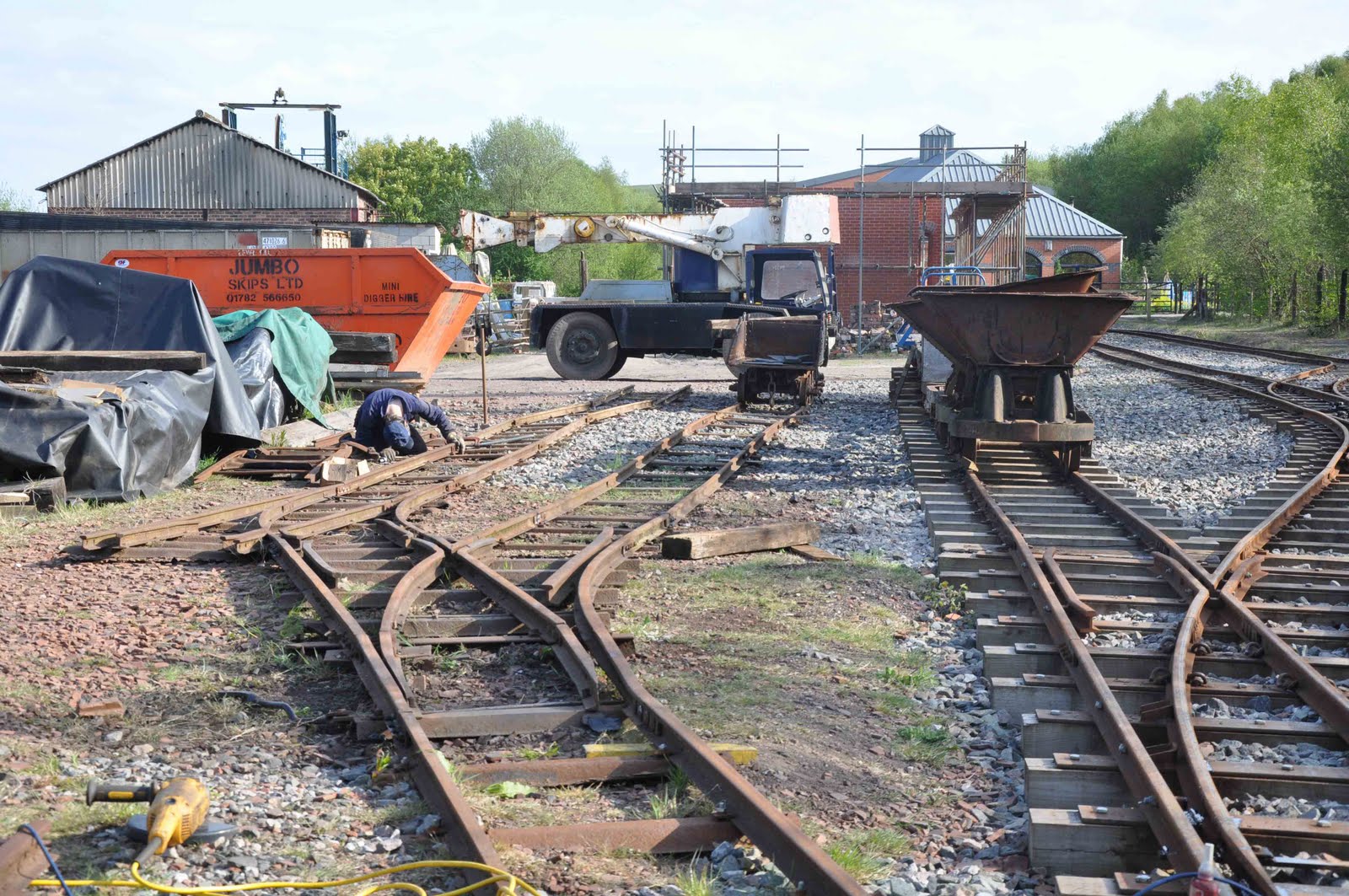
The day edges ever closer when the Moseley Railway Trust's Apedale Valley Light Railway opens to the public. A slightly embarrassing recent discovery was that we didn't have sufficient siding space to accommodate the fleet of wagons. The wagons have been stored on the main line during the construction phase, and used during the open weekends (this year's being 18 & 19 September - book the date now). However, having rafts of wagons on the main passenger running line is not really compatible with running passenger trains. HMRI take a dim view of that sort of thing. So, a swift programme of building extra storage sidings has been instituted. One of the plus points of narrow gauge railways is that storage sidings can be rapidly laid using preassembled Jubilee track panels. So, in the space of an afternoon, we turned an existing point through 180 degrees, which allowed a previously disconnected siding to become part of the general network. A second point was then manhandled into place, and another siding laid from that. What could be easier? In the First World War they did this sort of thing under shellfire. All we had to worry about was when the Heritage Centre ice cream store would be closed. Meanwhile, work has also progressed swiftly on the Hudson Toastrack coach; it now has completed airbrakes, and the flooring is mostly completed. The only way is upwards now for that project. Contact us here.